
Goble, P. (2001). Storm’s
maker tipi. New York, NY: Atheneum Books for Young Readers.
Storm Maker’s Tipi
is a collection of myths about how the Blackfoot Nation began to build tipis. The
first story is about the how a helper spirit, given to men by the creator,
decided to build mankind a shelter during the first storm. He was inspired by
the shape of a cottonwood leaf. The second story is about a man, named Sacred Otter, who had a
vision of the Storm Maker’s tipi where the Storm Maker told the man to paint
all tipis like his own. The final story is about another time Sacred Otter met with
the Storm Maker to negotiate safety for his village, and Storm Maker told him to
tie horse hair to the entrance of tipis for good luck.
***********************************
***********************************
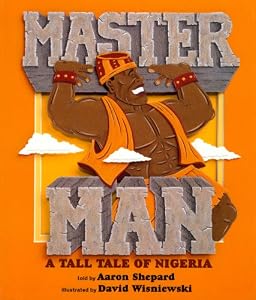
Shepard, A. (2001).
Master Man. USA: Harper Collins Publishers.
Master Man is
about a strong man, named Sahdusa, from Nigeria who thinks he is strongest in
the world. Sahdusa hears of someone who also clains to be the strongest, so Sahdusa
goes to challenge him. This other man turns out to be a giant, so Sahdusa runs
away, and while running meets another giant who also thinks he is the
strongest. The two giants fight to prove their strength, and they jump up into
the sky. They never came back down, and the sound of their fighting is thunder
and lightning.
***********************************
***********************************

McDermott, G. (2009). Pig
boy: A trickster tale from Hawaii.
Pig Boy is about a little Hawaiian pig. His grandma sings
over him, telling him will be full of magic. The pig gets himself into a lot
of trouble, but he always has the magic to escape. Whether he turns into a
hundred little pigs, grows to an enormous size, or turns into a fish, he always
gets away. At the end of the day, he goes back to his grandmother, who sings
him to sleep.
***********************************
***********************************

Taback,
Simms. (2005) Kibitzers and Fools; Tales
my Zayda Told Me. New York, New York:
Penguin Group.
Kibitzer and Fools is a collection of Yiddish folktales. It begins the book with an intro about how many Yiddish words are a part of our everyday speech, whether we realize it or not. It explains that Yiddish was the everyday language of Jews in Eastern Europe. Throughout telling the stories, it uses Yiddish words gives a definition in parentheses. Each story is based around a wise, old, Yiddish saying.
***********************************

Demi. (2004)
The Hungry Coat. New York, New York:
Simon and Schuster Children’s
Publishing Division.
The Hungry Coat
is a Turkish folktale about a man named Nasrettin Hoca. He was a very nice man,
but he always wore a big old turban and an old coat that was covered in
patches. One day, he went to a friend’s wedding, but everyone at the wedding
refused to talk to him because of what he wore. He left and got new clothes, came
back, and when everyone welcomed him, he started to feed his clothes all the
wonderful food. Everyone was confused, until the man explained that it must have
been the nice coat that everyone wanted at the wedding, not him, because they
only welcomed him when he had fancy clothes.
***********************************
***********************************

Compestine,
Ying Chang. (2001) The Runaway Rice Cake.
New York, New York: Simon and
Schuster Children’s Publishing Division.
The Run Away Rice Cake is about a poor Chinese family who made a
nain-gao for Chinese New Year that came alive and ran away. The family chased
it all through town and finally caught it next to an old woman who had not
eaten in days. Although the family didn't have much to spare, they gave the
nain-gao to the old woman. On their way home, some neighbors gave the family a
bit of food, but there was not much, so the parents gave it to the children, and
the oldest children gave it to the youngest. When the youngest offered it back to the rest of the family, it multiplied and they all feasted for the New Year.

No comments:
Post a Comment